Bitcoin Fork ECX Price Crashes 76% From Peak as Binance Hack Steals Spotlight – Bitcoin News
Key Takeaways
The $6.3 billion Binance hack overshadowed ECX’s debut, leaving its ambitious launch largely unnoticed.ECX commands a $639 million valuation, but its thin liquidity tells a more complicated story.Bitcoin forks face an uncomfortable reality in 2026, where market value matters more than technical pedigree.
Paul Sztorc’s Ecash Fork Debuts Amid Market Turmoil
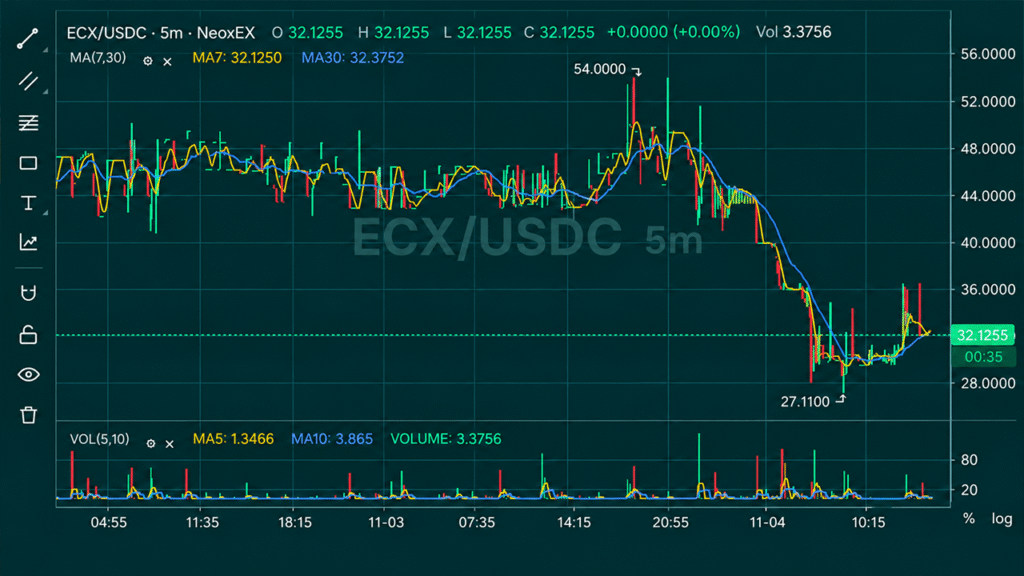
At 4:15 p.m. Eastern time on Wednesday, Nov. 4, 2026, ecash (ECX) was trading just above $32, having surrendered nearly 31% of its value over the preceding 24 hours. ECX serves as the native token of the Ecash blockchain, a Bitcoin fork spearheaded by Layertwo Labs founder Paul Sztorc.
Unlike the recent BIP110-Bitcoin Knots fork associated with Luke Dashjr, Sztorc’s ECX fork was deliberately orchestrated, granting nearly every BTC holder—with the exception of Satoshi Nakamoto—an equivalent ECX balance at a 1:1 ratio.
The blockchain’s rollout unfolded across three distinct phases, culminating in its mainnet debut on Oct. 29, 2026, coinciding with the 18th anniversary of the Bitcoin white paper the following day. By Nov. 4, 2026, the Ecash mainnet was actively producing blocks, supported by approximately 943 petahash per second (PH/s) of computing power, approaching the 1 exahash per second (EH/s) threshold.
Trading near $32 per ECX on Wednesday, the digital asset commands a market capitalization of approximately $639 million. That would put it near the bottom of the top 100 overall cryptocurrencies by market cap. Exchange support for ECX remains super limited, although Neoxa Exchange facilitates ecash trading, much like its support for the BIP110 fork. ECX’s USDC trading pair ranks as Neoxa’s third most active market by trading volume.

Did Binance’s $6.3 Billion Hack Bury ECX’s Debut?
ECX’s official rollout proved decidedly lackluster, as the Binance hack eclipsed the Ecash mainnet debut on the very same day, commanding vastly greater attention across the cryptocurrency industry. Even Luke Dashjr and the BIP110 faction’s fork appeared to attract considerably more publicity than Sztorc’s deliberately planned Bitcoin fork.
It’s safe to say that market participants were largely preoccupied with the $6.3 billion breach of the world’s largest cryptocurrency exchange by trading volume and its potential ramifications for the broader industry and digital asset markets.
Bitcoin Forks Face an Unforgiving Market in 2026
Among Bitcoin and its forks only, the newly launched token still ranks fourth by market capitalization (per eCash’s own website), behind bitcoin, bitcoin blake2b, and bitcoin cash. Bitcoin SV and the earlier Ecash blockchain, which split from bitcoin cash, both command market valuations below ECX. Nevertheless, almost all of those established networks have achieved considerably broader adoption than the newly introduced Ecash ledger, while Bitcoin Blake2b, trading under the tickers BTCB2 or the controversial XBT, also commands a higher price per coin.
While ECX changes hands near $32, BTCB2 commands a substantially higher price of $317 per coin at press time. Both assets inhabit sparsely adopted ecosystems, with limited exchange support and liquidity thinner than a strand of hair. Under such precarious trading conditions, even modest exchange swaps can send valuations careening faster than the Road Runner outsmarting Wile E. Coyote.
The broader lesson is that clever token distribution and marketing alone cannot conjure market relevance. A blockchain fork introduced amid an industry crisis must ultimately prove its worth through liquidity, exchange listings, and authentic demand rather than its technical lineage. Unless ECX cultivates meaningful utility and secures wider exchange access, even its initial valuation may prove little more than speculative noise.